|
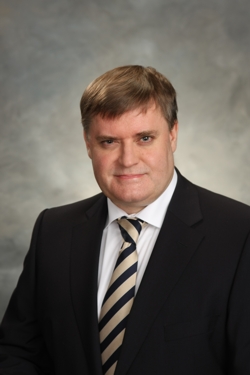
President and senior engineer of Behlke Power Electronics is Frank Behlke. Frank is doing professional electronic
design since more than 35 years and since 30 years he is specialized in pulsed power electronics and high-voltage semiconductor stacks. He is your first contact person in challenging projects. Frank is
an expert for analog electronics, pulsed power, EMC and practical electronic design. In the early eighties he worked as freelance engineer for several high-tech companies. He developed many measuring instruments for electrical and non-electrical
measurands, control systems and switch mode power supplies for very different applications. But his maybe most interesting job was at the Universities of Frankfurt and Muenster,
Germany from 1980 to 1987, when he worked as a privately employed electronic engineer for
Prof. Dr. Ing. Franz Hillenkamp (†2014) and Prof. Michael Karas, who
have been nominated for the 2002 Nobel Prize in Chemistry,
for the invention of the MALDI mass spectrometer, which became a worldwide instrument standard in chemical analysis. Frank developed and realized the electronics in
the early stage of this research project. He liked the job very much, but it became particularily exciting in summer 1985, when the scientists asked Frank to built a high-voltage pulser for some experiments with the ion lense of their LAMMA 1000
time-of-flight mass spectrometer (TOF-MS). In the same time the very first Power MOSFET came on the market and Frank knew immediately, that this
brandnew material could be the perfect base for another revolutionary new product.
Throughout the summer 1985 he experimented day and night with this new material and then he presented the first Fast High Voltage Push-Pull Switch in the
institute, which enabled the researchers to conduct special
experiments with the ion desorption process in the TOF-MS. The experiments were sensationally successful and they realised, that the instruments mass resolution can be improved dramatically by pulsing the acceleration voltage with a certain delay, a methode which experts call today delayed extraction. This
discovery was the initial trigger for Franks firm. |
|
 |
|
Frank Behlke behlke@behlke.com
|
|
|
|
He received a patent for his invention and still in 1985 he incorporated a small private enterprise, which was transformed very soon into a capital society with the former name Behlke Electronic GmbH. The company leased an inexpensive
office building
in the West of Frankfurt, Germany and began rapidly to expand. The scientists worldwide were very interested in the amazing characterictics of the Behlke HV switches and in the beginning, 95% of Behlkes customers were researchers and scientists. But Frank did not rest on his laurels. Over the years, Frank and his engineering team worked
very hard on the constant improvement of the solid-state switches. The high voltage switch, which has been originally designed for scientific purposes only, became a very professional and highly reliable industrial product. Many manufacturers of the laser- and medical industry asked for a reliable and cost efficient replacement for old thyratrons, cold
cathode tubes and spark-gaps and the BEHLKE switch perfectly fulfilled all the requirements. The switches proved their long-term reliability even in the harshest industrial enviroments. BEHLKE HV switches became an industry standard in hundreds of professional applications.
Today BEHLKE products are often used in safety-relevant medical equipment, as well as in military radar stations, which illustrates the high level of product quality, for which the BEHLKE team worked so hard over the past 25 years.
At the end of the nineties the facility in Frankfurt became too small for the production. In 1999 BEHLKE moved to
Kronberg,
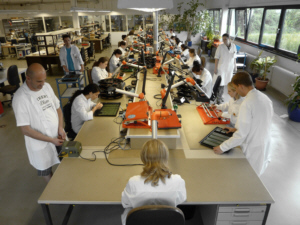
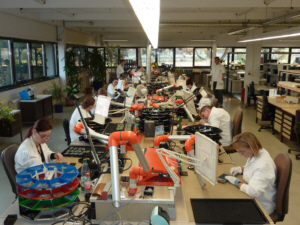
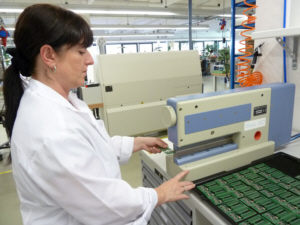
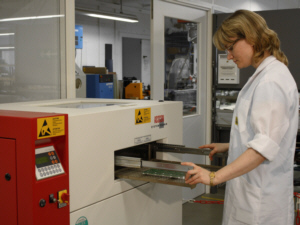
a small city about 15 miles North-West of Frankfurt, where two large industrial buildings were available by chance. Here was enough space to install all the large machinery neccessary for an efficient electronic manufacturing process. In the following years BEHLKE re-invested the profits in
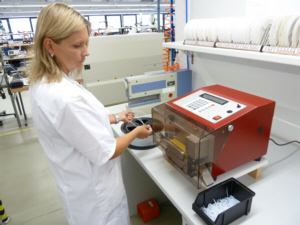
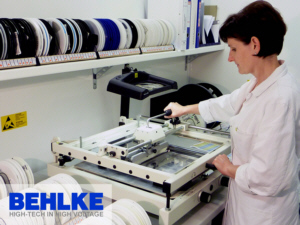
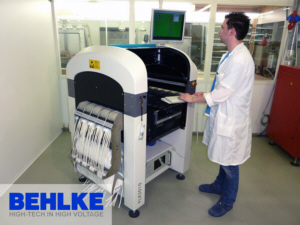
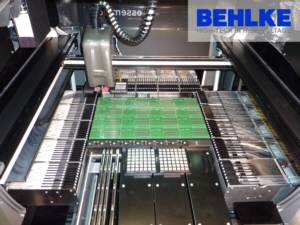
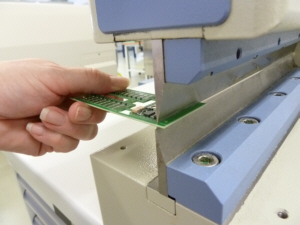
the development of new products and in modern manufacturing and laboratory equipment. In order to achieve a maximum part component density per built volume of the high-voltage switching modules, BEHLKE decided in 2007 to install an own surface mount (SMT) production line.
Nevertheless, in the meantime the production capacity in Kronberg is almost exhausted again and therefore BEHLKE has started to built up additional capacities in the USA. BEHLKE is worldwide active and delivers to almost every country. The export share is about 85% of the total business. Several local
sales representatives substitute BEHLKE especially in the Asian market. |
|
|